
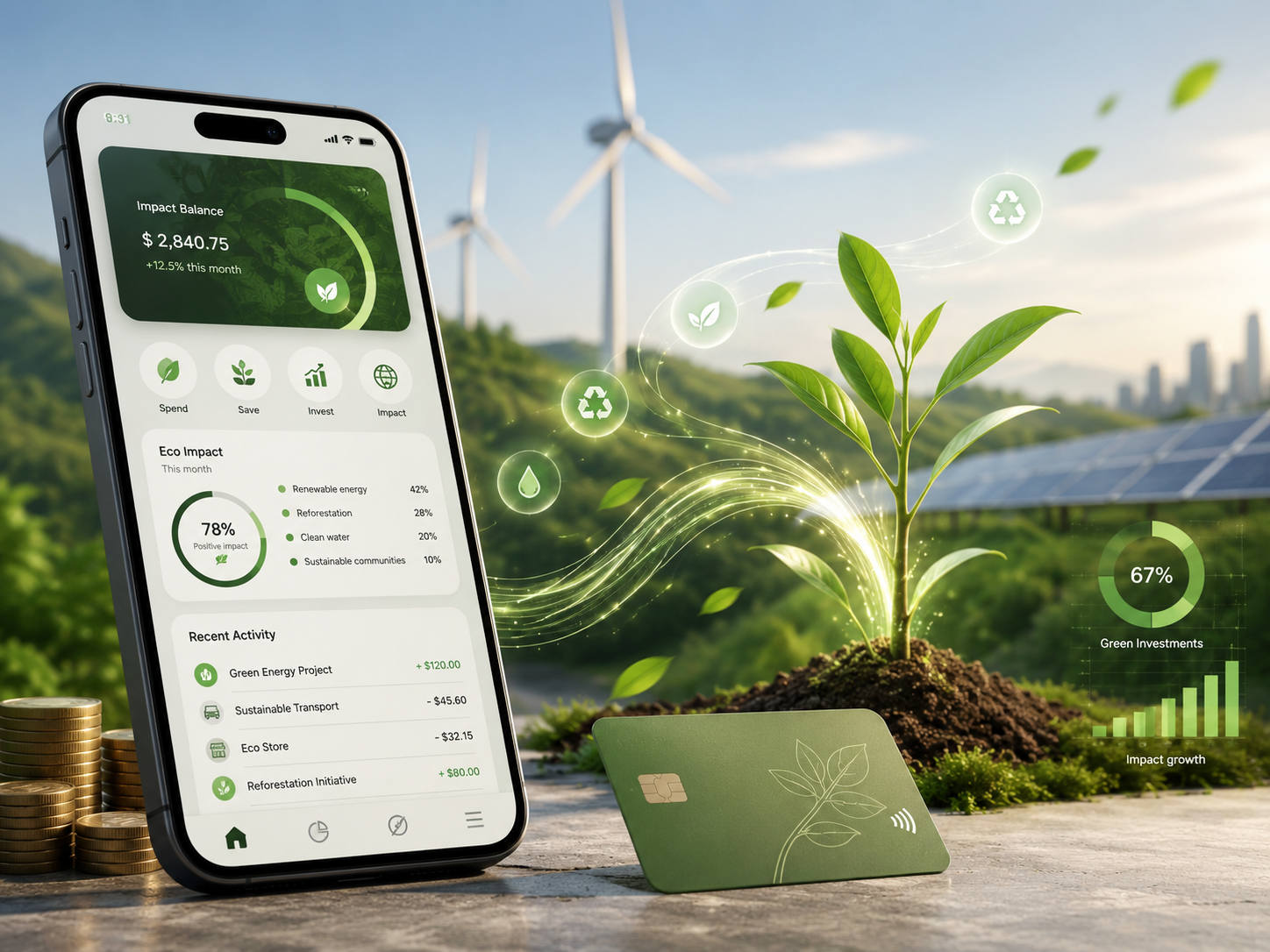
A bank account has long been viewed primarily as a tool for receiving a paycheck, paying bills, and building savings. However, a new generation of financial apps is trying to convince clients that by choosing a bank, they are also deciding which projects their money supports. So-called green neobanks therefore link mobile banking with tree planting, financing renewable energy sources, or excluding the fossil fuel industry.
Among the best-known examples are the Dutch bunq, the German fintech Tomorrow, and the American platform Aspiration, whose consumer division has continued under the GreenFi brand since 2025. Their products show that sustainability can be a significant part of the banking user experience. At the same time, however, they raise the question of how to distinguish measurable impact from a well-crafted marketing story.
A digital bank without branches may consume less paper and operational resources than a traditional institution. For the climate, however, it is more critical what happens with client deposits and into which assets, loans, or projects the financial institution directs its capital. This is precisely why the PCAF standard is creating a methodology for measuring financed emissions associated with loans and investments.
Green neobanks work with two layers of impact. The first is visible in the app: payments fund trees, round up transactions, or support specific projects. The second is less attractive for marketing but often more important: the rules determining where client money can and cannot end up.
Unlike many fintech apps, bunq is a bank with its own European license. It builds its ecological mission primarily on linking card payments with reforestation. The number of trees funded depends on the plan; for example, Elite plan users contribute to one tree for every 100 euros spent by card. bunq states that its community has ordered 50 million trees since 2019, using the veritree platform to track planting locations and subsequent care.
At the same time, the bank declares that, as part of its socially responsible investment policy, it does not invest money in fossil fuels, weapons, or tobacco. A strong point of bunq is its ability to translate the abstract topic of sustainability into a feature that the user sees directly in the app.
However, the number of trees alone does not indicate the final climate benefit. The species of trees, the suitability of the location, the additionality of the project, the survival of the trees, and the long-term protection of the area are all decisive factors. Moreover, carbon is stored gradually over decades, while emissions are created instantly. Planting can therefore be a valuable supplement, not an automatic substitute for emission reductions and a transparent investment policy. After all, the IPCC classifies afforestation as a tool for carbon removal, while also warning of limitations related to land use, biodiversity, and the long-term preservation of results.
Tomorrow positions itself as a sustainable alternative to conventional banks, but technically it is not an independent bank. It provides accounts through the licensed Solaris SE, which is subject to supervision by the German regulator BaFin and ensures statutory deposit protection. The brand therefore creates the product, the app, and the investment rules, while the regulated infrastructure is provided by a partner.
For 2025, Tomorrow reports 112 million euros in sustainable investments, approximately 30 percent of client deposits. The money went into green, social, and development bonds, issued among others by the European Union, regional governments, and the Nordic Investment Bank. Another 15.4 million euros was managed by the equity-based Tomorrow Fund, which excludes, for example, the coal and oil sectors.
Tomorrow uses a portion of card transaction fees for ecosystem restoration. According to its 2025 report, it supported the restoration of 2.8 million square meters of degraded land in South Africa. A positive signal is also the disclosure of financed emissions: 1,902 tons of CO₂e for the Tomorrow Fund and 17,916 tons of CO₂e for sustainable bonds. By doing so, the company admits an important fact – even a "green" portfolio is not emission-free, and its quality cannot be judged solely by its name.
At the same time, Tomorrow ranked among the highest-rated providers in the independent German Fair Finance Guide. However, the result must be read in the context of the business model: Tomorrow does not provide corporate loans, and it was primarily its investment guidelines and own investments that were evaluated, not the complete loan portfolio of a standard bank.
The American company Aspiration was long one of the most visible promoters of green banking. It offered rounding up payments for tree planting and declared that client deposits did not finance fossil fuel projects. The consumer part of its business was sold to Mission Financial Partners in 2024 and renamed GreenFi in April 2025. The current GreenFi is an independent fintech using partner banks and reported funding more than 3.47 million trees for 2025.
However, the original Aspiration Partners went bankrupt in 2025, and its co-founder Joseph Sanberg confessed to defrauding investors and creditors of 248 million dollars. The case did not directly concern the quality of the tree projects, but it showed a broader risk: a strong mission, certifications, and attractive impact metrics cannot replace sound corporate governance, audited finances, and trustworthy oversight.
Today, GreenFi explicitly states in its terms and conditions that trees from the Plant Your Change program are not certified carbon offsets, their planting can take up to 18 months, and their permanent survival cannot be guaranteed. Such a limitation of claims is actually a sign of higher transparency than a simple promise that one payment will automatically "erase" a certain amount of emissions.
The main criterion should not be the number of trees in the app. More important is who holds the client deposits, what rules apply to their investment, how broad the sector exclusions are, whether the institution measures financed emissions, and whether its data is externally verified. It is equally essential to distinguish between funding a planting, a tree actually planted, and long-term verified removal of carbon from the atmosphere.
European regulators view greenwashing in the financial sector as a growing reputational and operational risk. The European Banking Authority specifically highlights vague or unsubstantiated claims, discrepancies between declared strategies and actual practices, or products presented as green without the corresponding attributes.
Furthermore, starting September 27, 2026, the EU will implement the rules of Directive 2024/825, which strengthens consumer protection against general and unsubstantiated environmental claims. Consequently, an ecological mission will increasingly need to be supported by measurable investment policies, transparent methodology, and precise language.
Green neobanks have brought an important innovation to retail banking: they have shown clients that money in an account is not idle and that where it is placed has real consequences. A tree funded by a card payment can be both a useful symbol and a genuine contribution. However, the credibility of a green bank is not determined by an animation in a mobile app, but by whether it can document the entire flow of money – from the client's deposit to its environmental and social impact.